Adapting Waterfronts is a prototype interactive web-based tool (currently in beta) that
visualizes waterfront transformations past, present, and future to contextualize and inform
potential resilience strategies in the face of sea level rise and climate change events. Its
goal is to build place-based knowledge and serve as a platform for creative communication
amongst diverse stakeholders.
The interactive geospatial website allows for a three-dimensional viewing platform and
clickable features. Past, Present, and Future maps can be toggled on/off and layered on top
of each other. Historic maps make visible the unseen layers of time that illustrate
waterfront transformations and pre-development tidal ecology. Present maps include
three-dimensional buildings and show the current built and natural environment. Future maps
contain sea-level rise flooding scenarios. Geo-referenced photographs give the user an
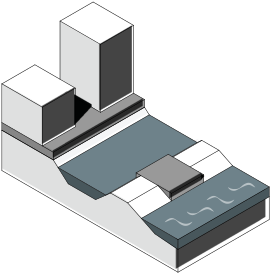
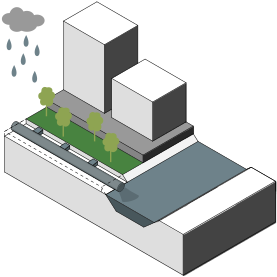
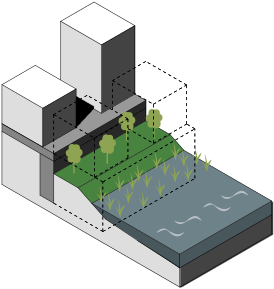
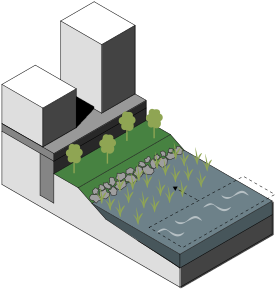
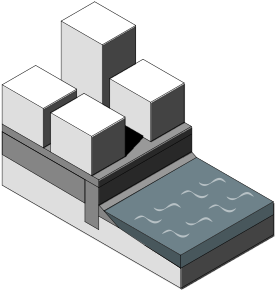
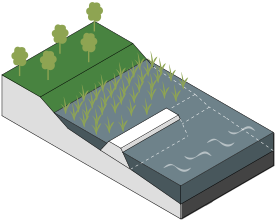
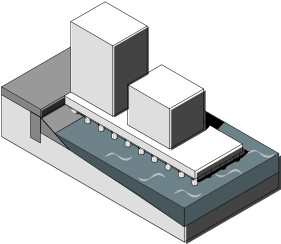
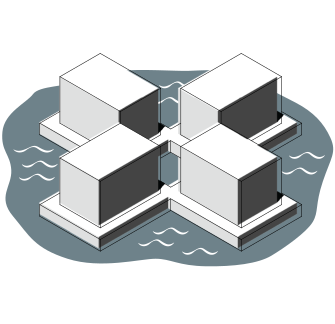
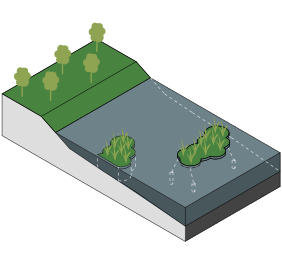
eye-level street perspective of past site conditions. Three-dimensional Resilience
Strategies visualize potential sea-level rise adaptation designs located In-Water,
Shoreline, and Upland.
All historic maps are from the David Rumsey Map
Collection. Images copyright © 2000 by Cartography Associates. Images may be reproduced
or transmitted, but not for commercial use. This work is licensed under a Creative Commons
License.
The sea level rise data was created by the
National Oceanic and Atmospheric Administration (NOAA) Office for Coastal Management. These
data depict the potential inundation of coastal areas resulting from a projected 2 to 10
feet rise in sea level above current Mean Higher High Water (MHHW) conditions. These data
illustrate the scale of potential flooding, not the exact location, and do not account for
erosion, subsidence, or future construction. Inundation is shown as it would appear during
the highest high tides (excludes wind-driven tides) with the sea level rise amount. A detailed
methodology for producing these data is available.
Additional maps layers were sourced from UC Berkeley Library, “GIS (Geospatial Information
Systems): California & Bay Area GIS Data.” All data is licensed under the Creative Commons
Attribution-Noncommercial 4.0 License.
Photographs were sourced from the Library of Congress online digital catalog and OpenSFHistory.org. Images were placed on their
approximate location on the map through a combination of methods including photograph
summary descriptions, on site observation, and previous geo-referencing by OpenSFHistory.
This website was supported and developed as part of a Faculty Fellowship at the Digital
Scholarship Center (now the Loretta C. Duckworth Scholars Studio) of Temple University
Libraries.
The map on this website is generated using the Mapbox GL JS
JavaScript library and the clickable features were created using QGIS. The historic maps were
georeferenced, converted to GeoTIFF format, and uploaded to Mapbox Studio as raster
files. The sea level rise data was converted from geodatabase format into KML, and the
resilience strategies were manually drawn in QGIS and converted to GeoJSON files. The menus
operate using the JQuery JavaScript
library and the horizontal sliders are an adaption of the glider.js tool
developed by Nick Piscitelli. Additionally, the About this Site section uses
the Magnific Popup
lightbox plugin developed by Dmitry Semenov.
The Adapting Waterfronts website is intended only for reference purposes. The data are
provided “as is,” without warranty of their performance or use. All risk associated with the
data and results is assumed by the user. All use of this website and reproduction of its
content should adhere to the Creative Commons License and rules of each data source. The
three-dimensional Resilience Strategies are meant strictly for visualization purposes and do
not constitute an adaptation planning strategy, nor do they represent an endorsement by the
authors of the website.
Email: adaptingwaterfronts@gmail.com